Tabular Model Definition Language (TMDL)
TMDL is a model metadata file format announced by Microsoft in April 2023. It aims to provide a human-readable, text-based alternative to the JSON-based model.bim file format. TMDL is inspired by YAML, and as such, is easy to read and write, with minimal use of string quotes and escape characters. It also serializes a model as several smaller files in a folder structure, and is therefore also better suited for version control integration.
Enabling TMDL in Tabular Editor 3
To enable TMDL in Tabular Editor 3, go to Tools > Preferences > File Formats > Save-to-folder, and select "TMDL" in the Serialization mode dropdown. The legacy "save-to-folder" functionality will continue to exist side by side with TMDL, but is not a Microsoft supported format.
After doing so, Tabular Editor 3 will use the TMDL format when saving a model as a folder (File > Save to folder...).
Note
When you load a model from a legacy Tabular Editor folder structure, it will still get saved into that same format when using File > Save (Ctrl+S). Only when you explicitly use the File > Save to folder... command, will the model be saved in the new TMDL format.
New models
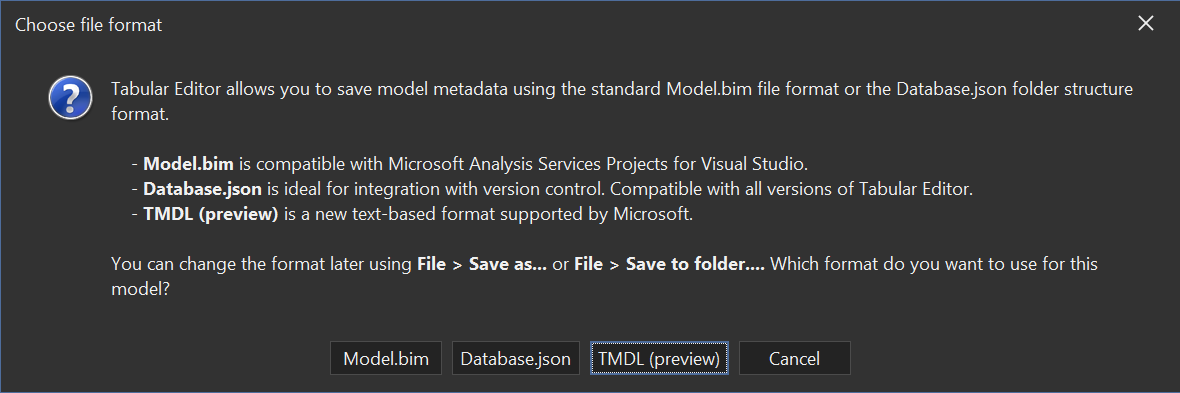
When saving a new model for the first time, Tabular Editor (since v. 3.7.0), will now provide an option for saving the model as TMDL, even when the default serialization mode is not set to TMDL, as described in the previous section.
TMDL and Microsoft Fabric Git Integration
TMDL is fully compatible with Microsoft Fabric's Git integration feature. When you use the Save with supporting files option in Tabular Editor 3, the TMDL serialization format creates a folder structure that includes all necessary metadata files required by Fabric's Git integration.
The resulting folder structure includes:
- .platform file with metadata (display name, description, logical ID)
- definition.pbism file with semantic model settings
- definition/ folder containing your TMDL model files
This combination allows you to commit your semantic models to Git repositories and synchronize them with Microsoft Fabric workspaces using Fabric's built-in Git integration capabilities. The human-readable nature of TMDL makes it particularly well-suited for code reviews and tracking changes in version control systems.
For detailed information on using this feature, see Save with supporting files.